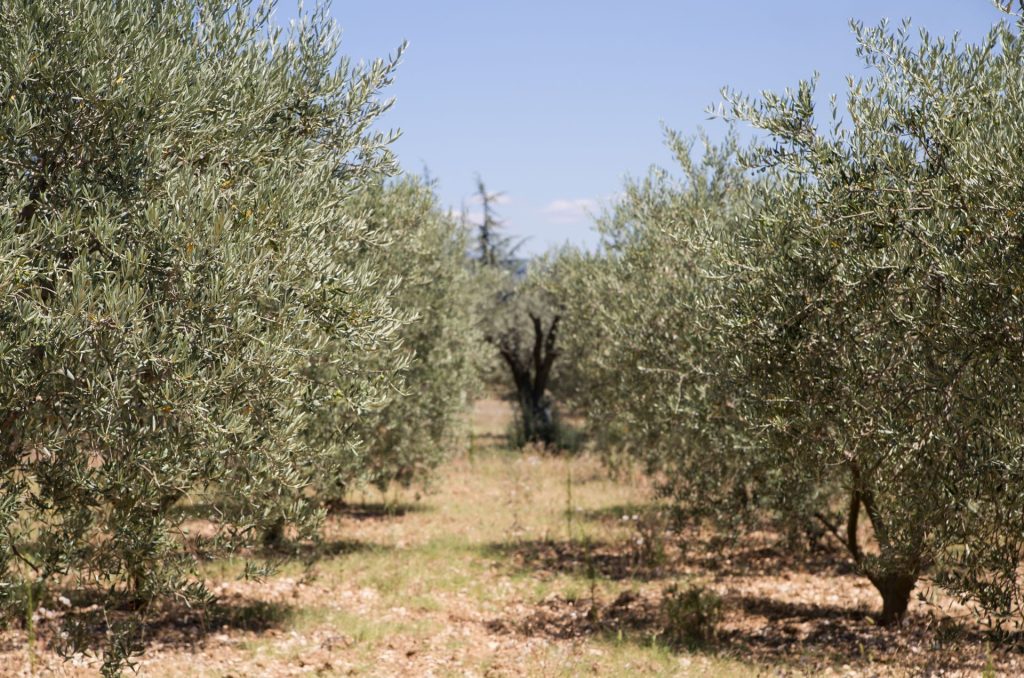

Olive trees have been with us for thousands of years. Howeverwhose cultivation methods have been evolving according to current needs and technologies. Remember, caring for a century-old olive grove growing on a steep hillside is different from caring for a century-old olive grove growing on a steep slope than caring for an olive grove growing on flat, spacious land. so, There are different types of olive cultivation. Each system has its logic…and the impact it has on olive oil, which is something that interests you as a consumer. We tell you!
What types of olive cultivation are there?
If you have ever passed through an olive growing area, you must have noticed Differences between some farms and others: Trees that are farther apart or closer together, larger or more compact canopies, fields that seem to be designed according to rules or fields that have a wild appearance… all of these are related to the type of olive grove cultivation that determines everything from how the land is worked to the type of machinery used. Now, What primarily determines whether we adopt one development model or another is the density of plantations.. When is it Traditional, Intensive, or Super Intensive?
traditional olive grove
The oldest type of olive cultivation is the traditional system, emblematic in regions such as Andalusia, Castile-La Mancha or Extremadura. In this case, the density range is 70 and 120 trees per hectare. So if you look closely you can see the olive trees in these farms completely separate from each other. This results in the sample developing The tree has a large crown, lush leaves and deep roots. They explore the terrain in search of water and nutrients.
Within the traditional olive grove you can also find two Variants.
- mechanizable: When a farm is located on relatively flat land and allows the use of machinery for farming and harvesting tasks. As you can imagine, this makes the job easier and reduces costs. This model is therefore used to produce olive oil in a traditional way, but without sacrificing efficiency.
- Not machinable: Typical areas with steep slopes or irregular terrain where the use of machinery is complicated or impossible. As a result, tasks such as pruning or harvesting must be performed manually or with lightweight tools, increasing costs.
Dense olive groves
In themselves, dense olive groves represent a modernization of the type of olive grove cultivation. It emerged to increase production and promote mechanization while maintaining a good balance between tradition and technology. Therefore, the density is usually between 200 and 600 specimens per hectare.
Trees are planted closer together to better utilize space and increase productivity. Apart fromolive trees have smaller, more manageable canopieswhich facilitates the use of machinery for pruning and harvesting. Of course, the requirement is mechanized simplicity, which is why such systems are commonly seen in Flat or slightly undulating terrain.
Super dense olive grove
Super-intensive olive groves are the newest and most talked about type of olive grove cultivation. The density here can exceed 1,000 or even 3,000 olive trees per hectare. With so many trees, organization is crucial. Therefore, they are planted in very narrow rows, forming a continuous hedge reminiscent of modern vineyards.
At the same time, the system allows Fully mechanized harvesting Use machines to travel quickly and collect olives with less labor. It is mainly used on flat and irrigated land, as ultra-dense olive groves require Precise control of moisture and nutrientsdue to the aggregation of specimens and consequent resource limitations.
Therefore, ultra-intensive olive groves require High initial investment Logically, this must require high and consistent production to be profitable. here, Efficiency and profitability are key to remain competitive.
Why use one crop or another?
Choosing between different types of olive grove cultivation is not a capricious decision. Behind it are calculations, experience, and in many cases conditions given by the nature of the terrain itself. One of the most important factors is economic profitability. Systems such as intensification or super-intensification can increase yields per hectare and reduce labor costs through mechanization. This is decisive for large or commercial farms.
The same thing happens with new plantations because Traditional olive groves take decades to reach optimal yieldscompared to 5 years of super reinforcement. Now, the higher the density, the higher the initial cost of the olive trees and the shorter their lifespan because they have more limited access to light or nutrients from the soil. In fact, you know what? In super-intensive crops, olive trees must be replaced every 12-14 yearscompared to traditional olive groves where trees grow for hundreds of years?
But not everything revolves around money. this topography Set clear boundaries. In areas with steep slopes or stony soils, traditional olive groves remain the only viable option. No machine can climb impossible slopes. also affects Soil type and water availability. For example, super-intensification requires deep soil and the ability to irrigate. Without these resources, performance will suffer.
Another very important reason is Brand or manufacturer goals. There are those who are dedicated to preserving the landscape, cultural and gastronomic value of traditional olive groves. Don’t forget that these more classic types of olive growing are often associated with very careful production, sometimes with high-value local varieties. Others, however, seek modern systems that guarantee high output and competitive prices.
How does crop type affect olive oil?
In short, the type of olive grove cultivation is selected by assessing tradition, technical feasibility and commercial strategies. Now, the decisions farmers make directly impact you as the consumer. How much impact do different models have on olive oil quality? The production system determines aspects such as the varieties grown, the timing of harvest, or the way trees are managed.
In traditional olive groveFor example, trees tend to have deep roots and more natural growth. This may facilitate more variable production, but also allows Obtain oils with complex sensory profiles closely associated with the region.
In intensive and super-intensive olive grovesharvesting is generally faster and more controlled, with a very short time between harvesting and grinding. this helps Picking olives at the best spot, Maintain fruit freshness, retain aroma and avoid premature oxidationdon’t forget the lower oil prices in the market.
Therefore, each system contributes differently and responds to different needs, but they are all part of a sector that combines tradition and innovation. that’s why, Understanding the type of olive grove grown is one way to measure the effort behind each bottle of olive oil.. If you are interested in continuing to discover curiosities, tips and secrets about the world of liquid gold, subscribe to the La Española blog where you will find practical content, cooking ideas and plenty of inspiration to make the most of this very special ingredient of ours.
PakarPBN
A Private Blog Network (PBN) is a collection of websites that are controlled by a single individual or organization and used primarily to build backlinks to a “money site” in order to influence its ranking in search engines such as Google. The core idea behind a PBN is based on the importance of backlinks in Google’s ranking algorithm. Since Google views backlinks as signals of authority and trust, some website owners attempt to artificially create these signals through a controlled network of sites.
In a typical PBN setup, the owner acquires expired or aged domains that already have existing authority, backlinks, and history. These domains are rebuilt with new content and hosted separately, often using different IP addresses, hosting providers, themes, and ownership details to make them appear unrelated. Within the content published on these sites, links are strategically placed that point to the main website the owner wants to rank higher. By doing this, the owner attempts to pass link equity (also known as “link juice”) from the PBN sites to the target website.
The purpose of a PBN is to give the impression that the target website is naturally earning links from multiple independent sources. If done effectively, this can temporarily improve keyword rankings, increase organic visibility, and drive more traffic from search results.