

What is a carbon footprint?
At HomeExchange, we have been voluntarily conducting our carbon footprint since 2019, and we have refined our calculations every year.
The carbon footprint coordinated by Bilan Carbon and Ademe (French Ecological Transition Agency) is a Methods for calculating company greenhouse gas emissions. Conducting an evaluation allows orders of magnitude to be obtained at the most issued carbon sites and developing an action plan for improvement.
Do you want to learn more about the operation of carbon footprint and the methods and scope of activity for HomeExchange? Please feel free to consult this article in our Carbon 2022 Assessment. (For the 2023 results, it’s here!)
Carbon assessments are conducted independently…and continually improved!
After using external tools, we will be with you in 2022 OUIACTThis is a cabinet recognized for its climate strategy expertise and it helps us build measurement tools that are more suitable for our specificity according to the Carbon® Bilan method.
Thanks to this tool, we can do a carbon footprint today while evaluating OUIACT so that it can be verified by expert companies.
This year, we have once again partnered with OUIACT to modernize the tool while also updating it to the latest broadcast factor.
Key Results and Courses in Our Carbon 2024
Emission results
According to our estimates, HomeExchange is responsible for the 2024 866,000 tons of carbon dioxideor an average of 648 kg of carbon dioxide per household.
This means +32% Significant increase compared to 2023, but lower than the growth in the number of travel we traveled, especially below the growth we recorded (in 2023 last year, we observed a 71% increase in our emissions, rather than 2022).
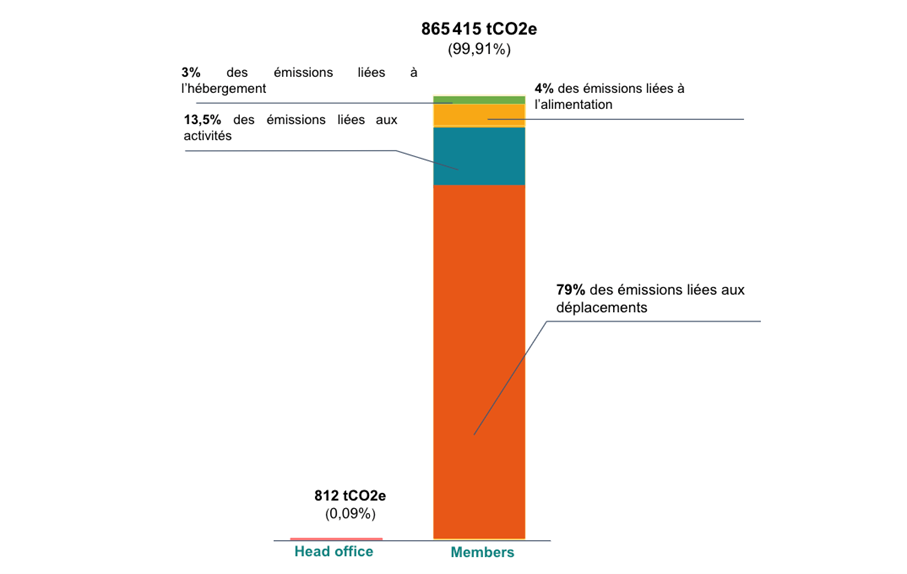
As you might expect – this is logically year after year – now it is 99,9% Greenhouse gas emissions from travel related to HomeExchange member travel. almost 80% This impact is related to travel.
Impact of the community: Emissions are not as fast as the number of exchanges
In 2024, we have observed a significant increase in the number of communications conducted by the community. However, our carbon footprint is not following the same curve, which is good news.
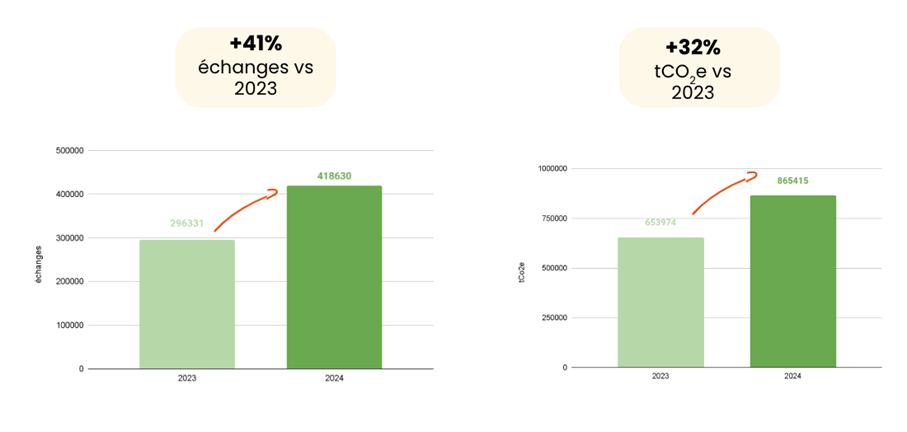
but, How to explain how our CO₂ emissions are progressing faster than the number of exchanges ?
- Reduced exchange ratio at a distance
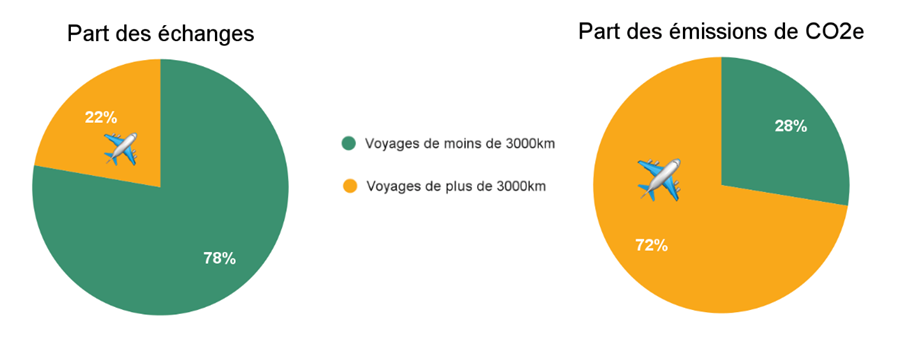
This development is largely explained by a decrease in the proportion of long-distance travel (over 3,000 km) (1 point).
The trips of these long-haul aircraft are heavy in our carbon footprint. For example, the round trip between Paris and New York, each sends nearly 2 tons of Co₂, just like dozens of trains or train trips that are shorter. So it is these travels that “lead” our carbon footprint.
💡
By reducing the share of remote travel, we can also mechanically reduce the average carbon footprint of exchange. Results: Our emission curve continues to increase, but is slower than our activity. This is good news and proves that individual choices – choosing closer destinations or favoring low-carbon transport – have real impact.
- Travel frequency, key factors
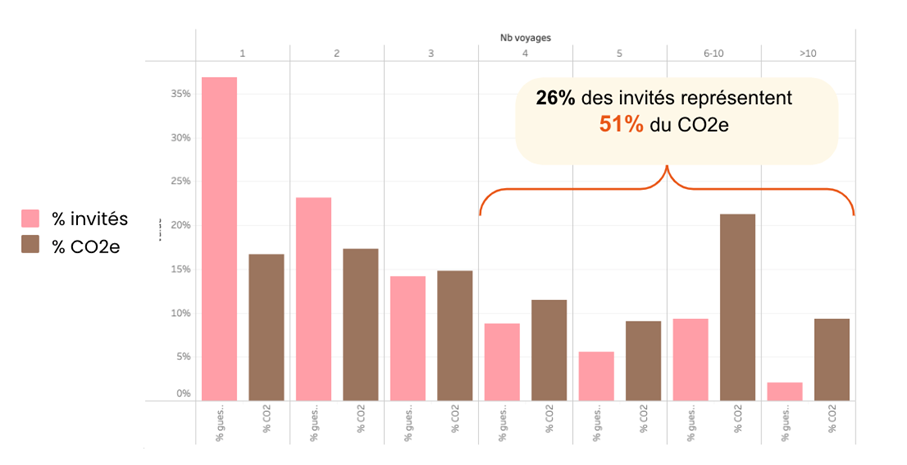
As part of this carbon assessment, we are interested in the planned breakdown of the number of trips conducted by each member. This approach provides a better understanding of how the frequency of communication affects global impact.
💡
In 2024, 26% of members Made Have 4 or more exchanges during the year. But they are responsible 51% of CO2 emissions Related to transportation.
When these trips are conducted with low carbon mobility (trains, carpooling, etc.), their impact remains limited. On the other hand, part of these stops is made by aircraft, whether for short or long stops, logically adding to the members’ carbon footprint.
The issuance issued by the aircraft, whether it is a 3-day or 3-week stay. Less travel, but longer,,,,, But it’s also far Allows you to limit its annual impact while promoting more immersive and often richer experiences.
Headquarters Emissions: One Approach, Carbon Footprint Reduces
The carbon footprint associated with the activities at our headquarters totaled 812 TCO2E, a 36% decrease from 2023. We will return to explaining the various reasons for this massive decline.
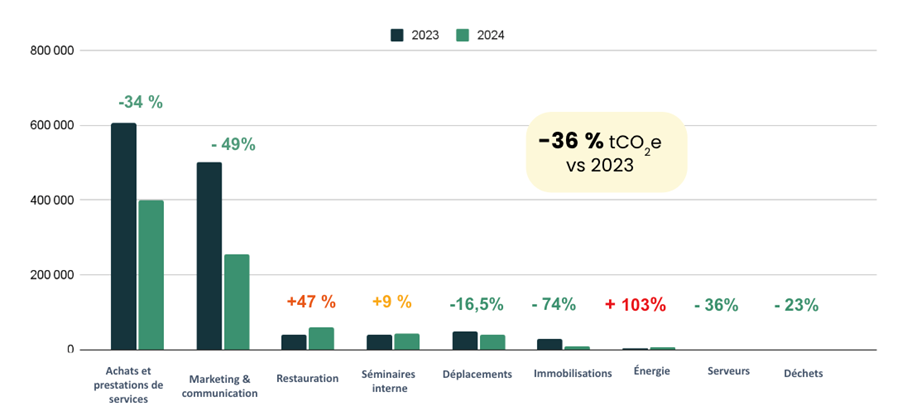
Key results and courses related to our headquarters for emissions
- Updates to emission factors
The subsequent emissions declines associated with our headquarters are partly due to Latest updates on ademe emission factorswe have integrated it into our tools.
Results: Some categories of our imprint have been actively re-evaluated, and in some cases old factors are considered overestimated. Therefore, this decline does not necessarily reflect a real decrease in our activity, but rather Improve data accuracy Used.
💡
These methodological adjustments make comparisons subtle from previous years, but they allow us to leave on a more reliable and coherent basis in the coming years. Part of the “Community’s Impression” is done through an equal approach and represents our largest emissions, and global comparisons remain relevant to 2023’s comparison.
- More reliable calculations of television-related emissions
In the process of continuous improvement, we want Get rid of the currency calculation model For certain categories, including those in TV advertising, this represents one of our largest broadcast positions. We have identified a reference study that enables us to Based on physical data (by access to the CO2 of the TV attractions) and no longer spend Euros.
💡
Even with this approach, the impact of advertising carbon remains large. As our international existence develops, Continuing to improve measurements at this location is key. In addition to broadcasting, our next location shooting will be taken locally as much as possible to limit the impact.
- Although the team expanded the impact of mastery
In 2024, the team grew from 105 employees to 134 people! Nevertheless, we know Includes certain emissionsespecially those related to professional travel and the impact of our annual workshops.
💡
These promises have also been experienced in daily gestures, and our co-founder was the first to showcase the example 🙂 One of them chose the train to interview Paris with Madrid, which illustrates our collective commitment to support low carbon liquidity.
The next step in 2025
Our main problem: liquidity
The assessment is clear: Transportation represents much of our environmental impact, and as communities grow, sustainable development is more important than ever.
Here is an overview of the actions implemented in 2024:
- Large-scale carbon footprint calculation activity on Earth Day (creating nearly 8,000 marks!)
- Writing Contest on Sustainable Journey (over 800 participants :))
- Carbon comparator for on-site transportation
- Create filters to seek accessible communications through public transportation
- H.
In 2025:
- We are conducting an academic research project to improve measurement of transport emissions and find ways to develop behavior
- We have developed a lot of content to promote train travel
- We are fully discussing partnerships with low-carbon liquid actors
- We had a bicycle surgery!
- There are many others 🙂
Let’s listen to you!
If you’re still reading, it’s because the theme of carbon is as fascinating as we do!
Do you have an idea, tip or project that can promote more sustainable travel when exchanging homes? Whether it’s a primitive way to travel low-carbon, a shared plan, or developing innovative services, we want to hear you!
👉
>Encourage close round-trip communication without airplanes
> Promote the use of trains, bicycles or other clean transportation
>Provide tools or services to promote sustainable mobility
>Any other suggestions that inspire our community
Write us the URL [email protected]!
In summary
We are proud to strengthen our carbon footprint by integrating the latest ADEME data accurate and transparency Our attention.
Even though the trend observed this year is encouraging compared to last year, we know it remains fragile, depending on many external factors.
In the context of a strong recovery in airflow after Pandemia, our responsibility is greater than ever. Tourism now accounts for 9% of global emissions, and its emissions are growing faster than other sectors.
It is believed that change will come from others – public policy, behavioral change or technological innovation. But to really change the practice, Everyone has a role. As travel actors, we must assume our share, thereby facilitating access to specific alternatives and promoting more sustainable travel options.
It is by making these choices simpler, more obvious, and preferable that we can contribute to the development of habits and promotion of tourism – indeed – more responsible.
Best Recipe
Game Center
Game News
Review Film
Berita Terkini
Berita Terkini
Berita Terkini
review anime


